

Your car communicates its physical condition through sound. Long before a warning light illuminates on your dashboard or a cloud of steam rises from under the hood, subtle mechanical changes produce distinct audible clues. A faint squeak during a cold start, a low hum that builds at highway speeds, or a rhythmic clicking on tight turns are all early warnings of component wear.
Diagnosing automotive sounds requires a systematic approach. Rather than telling a mechanic your car is “making a noise,” you need to track four specific variables: the pitch of the sound (squeal, grind, knock, or hum), its location (engine bay, wheels, exhaust, or driveline), its timing (constant, intermittent, or speed-dependent), and the exact operating condition that triggers it (accelerating, braking, idling, or turning). This guide breaks down the most common automotive noises, explains their underlying causes, and provides clear guidelines on whether you can safely drive to a shop or need to pull over immediately.
Deciphering High-Pitched Belt Squeals and Accessory Slippage

When you start your engine and hear a sharp, piercing squeal that rises in pitch as you step on the gas, the culprit is almost always located in your front accessory drive system. Modern engines rely on a single, continuous serpentine belt to drive multiple critical components, including the alternator, power steering pump, water pump, and air conditioning compressor. Over time, heat, oil exposure, and mechanical tension cause the rubber on this belt to harden, glaze, or crack.
A high-pitched squeal occurs when the rubber belt loses its grip and slips against the smooth steel pulleys. If the sound happens primarily on damp mornings or when turning on heavy electrical loads like headlamps and defrosters, the belt is likely loose or worn. However, the belt itself is not always at fault. An automatic belt tensioner uses an internal spring to maintain proper pressure. When this spring weakens or its internal pulley bearing fails, the belt slacks, leading to continuous slipping. Inspecting your serpentine belt for fraying edges, micro-cracks across the ribs, or shiny, glazed contact surfaces helps identify wear before the belt snaps entirely.
Not all front-end noises are high-pitched squeals. A low-frequency whine or groan that grows louder when you turn the steering wheel to its lock position points directly to the power steering system. This noise is often caused by low fluid levels, which allow air to mix with the hydraulic fluid—a condition known as fluid cavitation. The air bubbles pass through the power steering pump, creating an audible mechanical groan. Checking fluid levels promptly prevents internal pump damage.
Similarly, a high-frequency, metallic whine that increases with engine speed, independent of steering input, often signals a failing water pump bearing or alternator bearing. Scheduling regular car tune ups helps catch worn drive belts, failing tensioners, and fluid leaks long before they leave you stranded on the side of the road. Partnering with a reliable auto repair company ensures these wearable engine bay components are replaced using high-quality parts before catastrophic mechanical failure occurs.
Spotting Valvetrain Ticking and Top-End Wear
Engine bay noises generally fall into two distinct mechanical categories: top-end valvetrain issues and bottom-end rotating assembly problems. Distinguishing between a light metallic tick and a heavy, hollow knock is one of the most critical diagnostic skills any driver can develop, as it marks the difference between a routine component replacement and a complete engine rebuild.
A light, rhythmic tapping or clicking coming from the top portion of the engine is usually related to the valvetrain. Hydraulic lifters, rocker arms, and intake or exhaust valves operate at half the speed of the crankshaft. If oil pressure is low, if the engine is running on dirty fluid, or if valve clearances are out of adjustment, you will hear a rapid “tick-tick-tick” that speeds up as you rev the engine. While a sticky hydraulic lifter requires attention, it rarely causes instantaneous engine destruction, giving you time to drive carefully to a qualified auto repair shop for diagnosis.
To properly isolate valvetrain noise, pay close attention to engine temperature and fluid conditions:
- Cold Start Ticking: Often caused by low oil levels or oil that is too thick, delaying hydraulic pressure build-up to the upper engine head.
- Warm Engine Ticking: Points toward worn rocker arm pivots, collapsed lifters, or excessively loose valve lash clearances.
- Exhaust Manifold Pulse: Can mimic a valve tick, but usually changes tone as the engine compartment heats up and metal components expand.
Addressing top-end valvetrain noises early keeps your engine running smoothly and prevents premature camshaft or valve damage.
Recognizing Heavy Rod Knocks and Critical Bottom-End Failure
In sharp contrast to top-end ticking, a heavy, deep, metallic thud coming from the lower section of the engine block—commonly known as “rod knock”—is an absolute mechanical emergency. This sound occurs when the precision bearings surrounding the crankshaft wear down, creating microscopic play between the connecting rod and the crank journal. Every time the spark plug fires and forces the piston downward, the loose rod slams against the crankshaft.
A rod knock is loud, sharp, and unmistakably heavy. If you hear a deep bottom-end knock, you must safely pull off the road and shut off the engine immediately. Continuing to run an engine with rod knock will break the connecting rod, punching a hole through the engine block and turning a repairable bottom-end service into a total engine replacement.
Heavy-duty commercial vehicles and passenger rigs powered by compression-ignition engines produce a unique set of baseline operational sounds that differ significantly from gasoline engines. Knowing how to distinguish normal fuel-injector chatter from serious combustion timing issues or failing turbocharger bearings is essential for heavy-duty operators. If you operate a high-compression vehicle, seeking specialized diesel repair ensures that fuel delivery systems, glow plugs, and heavy-duty turbo assemblies receive the exact tolerances and high-pressure fluid checks they require to function reliably.
Distinguishing Brake Squeals from Metal-on-Metal Grinding
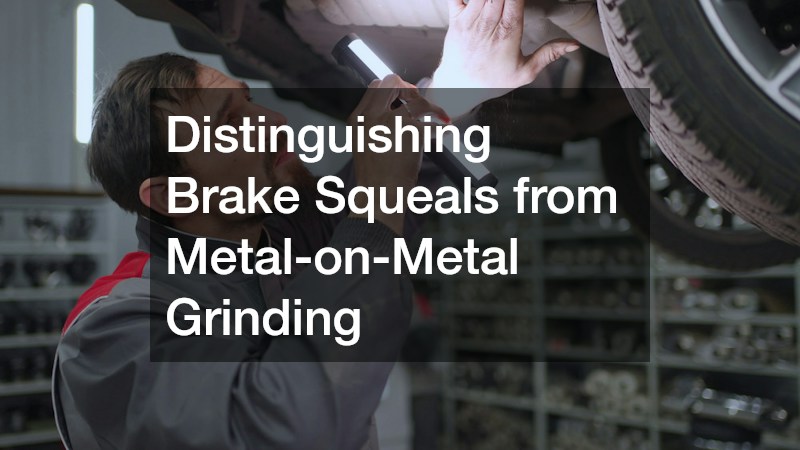
Your wheels and braking assemblies are subjected to extreme heat, rotational friction, and constant exposure to road grit, water, and de-icing chemicals. Because these components are directly tied to vehicle control and stopping capability, any unusual sound originating from the wheel wells demands immediate investigation.
Brake systems are intentionally designed to give clear audible alerts as friction materials wear down. Most modern brake pads feature a small, spring-steel tab called an acoustic wear indicator. When the friction material wears down to roughly 2 to 3 millimeters, this metal tab makes contact with the spinning brake rotor, producing a high-pitched, continuous squeal whenever the vehicle is in motion. Notably, this wear squeal often disappears when you apply the brakes. If you hear a persistent squeal while cruising that stops when you depress the brake pedal, your pads have reached the end of their service life and require prompt replacement.
If you ignore the wear indicator squeal, the friction pad material will eventually wear away entirely, leaving the steel backing plate to press directly against the cast-iron rotor. This produces a harsh, raspy grinding sound accompanied by a pulsing sensation in the brake pedal. Metal-on-metal grinding severely gouges the rotor surface, drastically reduces stopping power, and generates intense heat that can damage brake calipers and wheel seals. Scheduling an immediate brake repair service ensures your calipers, rotors, and pads are fully restored before stopping safety is compromised.
Diagnosing Wheel Bearing Hums and Suspension Clunks
Beyond the braking mechanism itself, the hub assembly housing the wheel bearings can fail over time. A failing wheel bearing creates a low, roaring hum or deep drone that sounds similar to driving over rumble strips or having mud tires installed. This sound typically starts around 30 mph and grows louder as road speed increases. A key diagnostic test for a failing wheel bearing is lateral weight transfer: when swerving gently side-to-side on an open road, the drone will intensify when turning in one direction (loading the bad bearing) and quiet down when turning the opposite way (unloading it).
Suspension components also create distinct noises when they wear out or lose their protective grease coatings. Worn ball joints, blown strut mounts, and dry sway bar links produce heavy clunks or creaks when driving over speed bumps or rough road surfaces. Comprehensive auto service checks catch failing wheel hub assemblies and loose suspension joints before a bearing seizes or a ball joint separates entirely.
Identifying Exhaust Leak Roars and Manifold Ticks
An engine is essentially a large air pump, drawing in air, burning it with fuel, and expelling high-pressure hot exhaust gases. The exhaust system must manage these roaring combustion waves, route toxic gases away from the passenger cabin, and muffle noise down to legal levels. When cracks, rust holes, or blown gaskets open up in the exhaust path, the resulting sounds are immediate and obvious.
An exhaust leak located near the front of the vehicle—such as a cracked exhaust manifold, a failed flex pipe, or a blown manifold gasket—produces a sharp, metallic “ticking” or “puffing” sound that is most prominent during hard acceleration under heavy load. Because the manifold is directly attached to the engine cylinder head, escaping high-pressure exhaust pulses sound remarkably like valvetrain clatter. However, unlike valve ticks, exhaust leaks usually quiet down slightly as the engine warms up and the metal exhaust components expand, partially sealing the gap.
If a hole opens up further down the exhaust line in the piping, resonator, or muffler, the vehicle will lose its sound dampening entirely, transforming a quiet sedan into a loud, roaring vehicle that sounds like a lawnmower or race car. Beyond the loud noise, an exhaust leak anywhere beneath the body poses a severe safety risk: carbon monoxide gas can seep up through the floorboards and enter the passenger cabin.
Fixing Rattling Heat Shields and Cabin Wind Noise

Another common exhaust-related noise is a bright, high-frequency metallic rattling or buzzing that occurs primarily at specific engine speeds or while idling at a stoplight. This sound is rarely a structural engine problem; instead, it is usually caused by a loose, rusted, or broken catalytic converter heat shield. These thin aluminum or steel shields are clamped around hot exhaust pipes to prevent radiant heat from igniting grass beneath the car or damaging floorpan insulation. When their spot welds rust through, the shield vibrates wildly against the exhaust pipe.
In some cases, cabin noise is caused by structural impacts or body damage rather than mechanical drive components:
- Loose Underbody Panels: Bumper covers, fender liners, or underbody splash shields that become loose after a minor collision can flutter against tires or flap in the wind, producing loud drumming or scraping sounds at highway speeds.
- Damaged Weatherstripping: Degraded door seals and worn window channels let high-speed airflow enter the cabin, creating loud aerodynamic whistles or rushing air sounds.
- Improper Window Modifications: Poorly fitted window films or aftermarket window accessories can alter airflow channels around cabin glass, leading to persistent wind whistle.
Seeking professional auto body service ensures structural panels, bumper supports, and underbody aerodynamic guards are securely anchored. Additionally, addressing car tinting errors and replacing degraded door seals restores quiet cabin conditions and eliminates irritating aerodynamic noise.
Locating Driveline Clunks and CV Joint Clicking
The driveline transfers mechanical rotational energy from the transmission output shaft down to the drive wheels. This system includes driveshafts, universal joints (U-joints), constant velocity (CV) joints, differentials, and transaxles. Because these components endure high torque loads, wear shows up as clunks, thuds, and speed-dependent vibrations.
A heavy metallic “clunk” or “thud” that occurs specifically when shifting from Park into Drive or Reverse, or when stepping on and letting off the gas pedal while cruising, indicates excessive backlash or slop in the driveline. In rear-wheel-drive and four-wheel-drive vehicles, this is frequently caused by worn U-joints on the main driveshaft or deteriorated rubber differential mounting bushings. When the universal joint needle bearings dry out and collapse, the driveshaft rotational play snaps against the yoke ears every time torque direction changes.
Front-wheel-drive vehicles utilize CV axles fitted with flexible rubber accordion boots that hold heavy grease around high-precision ball bearings. Over time, road debris or heat splits the rubber boot, flinging protective grease out onto the suspension and allowing dirt and water inside. Once dry, the CV joint wears rapidly, producing a distinct rhythmic clicking or popping sound when making sharp turns at low speeds, such as navigating a parking lot or making a U-turn. Addressing driveline clunks and clicking CV joints early prevents sudden driveshaft separation or complete loss of power to the drive wheels.
Following the Red-Alert Protocol for Emergency Pull-Overs
Not every car noise demands an emergency response on the shoulder of a highway, requiring you to immediately call a local towing service. A squeaky brake wear indicator or a loose heat shield gives you time to safely schedule an appointment with a mechanic. However, certain severe operational noises signal imminent mechanical destruction or complete loss of vehicle control. Knowing how to react within seconds when these critical sounds occur can prevent accidents and save thousands of dollars in mechanical damage.
The “Stop Driving Now” criteria are absolute. Turn on your hazard lights, ease off the accelerator, and pull off the roadway as far to the right shoulder as safely possible if you experience any of these critical situations:
- Heavy Metallic Knocking from the Engine: A deep bottom-end rod knock means an internal engine component is moments away from breaking through the engine block. Shut off the ignition as soon as you stop safely.
- Loud Screeching with Warning Lights: If a serpentine belt snaps entirely, you will hear a loud whip-like snap or screech followed immediately by the battery charging light illuminating, heavy steering, and a rapidly rising engine temperature.
- Harsh Metal-on-Metal Grinding with Brake Pedal Loss: If applying the brake pedal produces a violent grinding sound accompanied by the pedal sinking to the floor, a hydraulic line has failed or a caliper has seized.
- Sudden Loud Popping Followed by Violent Flapping: A sudden gunshot-like pop followed by a loud, rhythmic “thump-thump-thump” indicates a tire blowout. Hold the steering wheel firmly and coast to a safe stopping area without slamming on the brakes.
Taking quick, composed action during an emergency sound event keeps you, your vehicle, and other drivers safe.
Listening to Your Vehicle for Long-Term Reliability

Your automobile is a complex assembly of mechanical, hydraulic, and electrical systems working together under extreme physical stress. Paying close attention to the baseline sounds your car produces during normal daily operation is the single best way to catch mechanical wear early and avoid an emergency call to a towing company. When a new sound appears—whether it is a light chirp on cold starts, a faint tick under acceleration, or a quiet hum at highway speeds—do not wait for it to disappear on its own.
Keep a written note in your glovebox or smartphone logging when the sound occurs, how it responds to vehicle speed or engine load, and what operating conditions trigger it. Presenting these specific observations to a certified technician saves diagnostic time and ensures accurate repairs. By taking immediate action when your car communicates through sound, you protect your investment, maintain maximum vehicle reliability, and ensure peace of mind every time you get behind the wheel.
Keep a written note in your glovebox or smartphone logging when the sound occurs, how it responds to vehicle speed or engine load, and what operating conditions trigger it. Presenting these specific observations to a certified technician saves diagnostic time and ensures accurate repairs. By taking immediate action when your car communicates through sound, you protect your investment, maintain maximum vehicle reliability, and ensure peace of mind every time you get behind the wheel.